Tag Archive for 'Diet'

Vegans – Join Blog Action Day

The folks at Change.org will be hosting Blog Action Day again this year, with a focus on Climate Change.

It’s a great opportunity to remind people of the link between animal-based agriculture and climate change.

Related links:

Audubon Magazine on Diet and Global Warming

(Via Vegan.com)

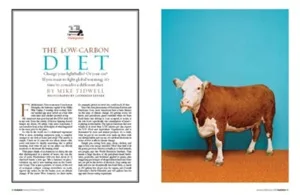
Excellent piece by Mike Tidwell in Audubon Magazine: The Low Carbon Diet.

The Low Carbon Diet

The Low Carbon Diet

I was a bit concerned when Tidwell opened with the usual “confession” that so many apologias for meat eating use, a trope I’m tired of reading:

Full disclosure: I love to eat meat. I was born in Memphis, the barbecue capital of the Milky Way Galaxy. I worship slow-cooked, hickory-smoked pig meat served on a bun with extra sauce and coleslaw spooned on top.

It always feels to me like a defensive posture that ought to be unnecessary, and serves to distance the author rhetorically from the position he or she is about to take.

But the piece as a whole is actually a welcome contribution to the ongoing work of trying to get environmentally aware omnis to start thinking about the impact of their diet:

The facts speak for themselves. If we really want to fight climate change, we should change our lightbulbs and purchase hybrid cars and, above all, vote for politicians committed to a clean energy future. But we should also eat less meat, a lot less, or none at all.

Tidwell acknowledges the challenges of changing consumer behavior, and the irrational reactions people have when you break taboo and start talking to them about what they eat, but argues that the connections need to be made:

one’s ideas about food reside in the same part of the brain that houses our ideas and beliefs about religion. It’s not all rational, in other words. . . .

. . . for people to care, the climate–food discussion must be about more than just facts, more than pounds of greenhouse gases per units of food. It’s got to be about morality, about right versus wrong. And I don’t mean the usual morality of environmental “stewardship.” Or even the issue of cruelty to farm animals. I’m talking here about cruelty to people, about the explicit harm to humans that results from meat consumption and its role as a driving force in climate change. Knowingly eating food that makes you fat or harms your local fish and birds is one thing. Knowingly eating food that makes children across much of the world hungry is another.

Of course, as an ethical vegan, I think the “cruelty to farm animals” ought to have a significant impact on one’s choices too, but I’m happy to see a mainstream environmental publication take issues of food policy on directly.

NPR Gets the Point – Minimizing Greenhouse Gases Through Diet

I’ve blogged a fair amount (too much, some might say) on the connections between global warming and animal agriculture – it’s the true inconvenient truth that many meat-eating environmentalists have no interest in hearing, and many mainstream media outlets have little interest in reporting. (Gee, I assume that has no connection with whom the major advertisers media court are, does it?)

That’s why I was so happy (as an ardent NPR supporter and member of three NPR stations – KCRW, WERS, and KEXP) to hear this story on NPR:

In honor of Earth Day this week, we offer a series of conversations about food’s footprint. Alex Chadwick talks to Dr. Gina Solomon, a senior scientist with the National Resource Defense Council, about how the food we eat contributes to greenhouse gasses.

Give it a listen, especially if you consider yourself an environmentalist, but still eat a diet heavy on animals and animal byproducts.

The Cheeseburger Footprint

Just came across an excellent post from Jamais Cascio on the Carbon Footprint of the Cheeseburger

In summary, he concludes:

To make it clear, then: the greenhouse gas emissions arising every year from the production and consumption of cheeseburgers is roughly the amount emitted by 6.5 million to 19.6 million SUVs. There are now approximately 16 million SUVs currently on the road in the US.

In other words, the average American’s diet of cheeseburgers has more impact that all the SUVs on the road.

His point isn’t just about cheeseburgers, though:

The Cheeseburger Footprint is about much more than raw numbers. It’s about how we live our lives, and the recognition that every action we take, even the most prosaic, can have unexpectedly profound consequences. The article was meant to poke us in our collective ribs, waking us up to the effects of our choices.

There’s also now a video available, from a segment on Six Degrees: